Hydrofacial Machine (Water & Oxygen Jet Facial System) for UK Clinics
What a hydrofacial machine costs to run in a UK clinic: consumables per treatment, special treatment licence checks and the questions your quotation must answer.
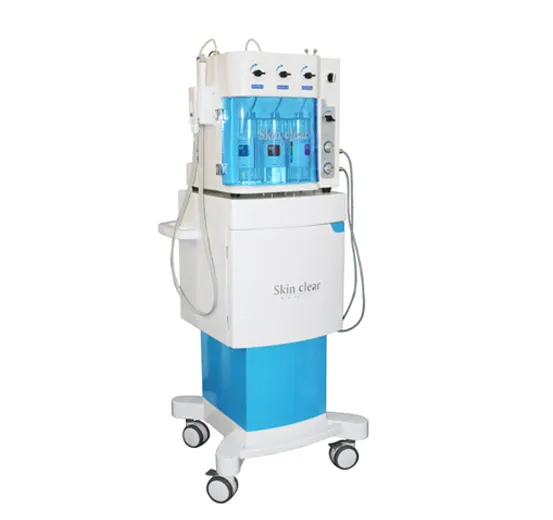
Hydrofacial machine vs microdermabrasion: what the difference means for your licence
A hydrofacial machine is not microdermabrasion. Microdermabrasion scrapes surface cells away with abrasive particles or a diamond tip; peer-reviewed literature describes hydradermabrasion as negative-pressure exfoliation with liquid infusion, closer to the W01 on this page. The category also sells as a hydradermabrasion machine, or a hydro facial machine. HydraFacial® is a registered trademark we don't supply; our W01 is a separate water and oxygen jet machine.
The distinction matters on your licence application and in the claims you make to clients. Councils and insurers work from the machine description you hand them, not a brochure category name. Our hydrofacial machine buying guide sets out the three technologies inside the machine and the specifications to compare.
How a W01 facial runs, step by step
The W01 ships with the water-oxygen jet as its base function, plus three handpieces: vacuum, RF and microcurrent. Pressurised water and oxygen go through a jet nozzle; the vacuum handpiece lifts the loosened debris away. It is marketed for deep cleansing of congested pores and follicles, hydration and a temporary lifted, firmer look in one session; results vary by client and protocol.
Order of play: cleanse the face, then work the forehead, cheeks, chin, nose and periorbital area, with the client in eye patches. Hold the handpiece at 45 to 90 degrees: closer in for stronger peeling, further out for gentler work. Working distance, spray pressure and speed set the intensity. Brief redness afterwards is normal, with usually no downtime. For acne-focused follicle cleaning, our hyperbaric oxygen facial machine may suit you better.
Get the diary numbers in writing before you price the treatment: treatment time, the cleaning and consumable-change turnaround between clients, and the recommended course length and interval are confirmed in the training pack supplied with each unit, not estimated here. They decide whether the facial fits your 45- or 60-minute column. Keep the training certificate on file too: insurers and council licensing officers ask for it.
Consumables and running costs: what UK clinics usually underestimate
The machine is a one-off; tubing, jet nozzles and nutrient solution recur. Every W01 quotation sets out pack size, treatments per tip and the per-treatment consumable cost; fill this table in from yours.
| Consumable item | Pack price (ex-VAT) | Treatments per pack | Cost per treatment |
|---|---|---|---|
| Water-oxygen jet nozzle | — | — | — |
| Tubing set | — | — | — |
| Nutrient solution | — | — | — |
| Vacuum filter | — | — | — |
Ask four things alongside the prices: whether tubing is single-use or multi-use and what cleaning and disposal it needs between clients (cross-contamination is a standard inspection point); the vacuum filter's replacement interval in treatments rather than months, because a blocked filter drops suction and changes intensity; the nutrient solution's shelf life once opened; and the UK replacement lead time on each line.
UK compliance you cannot skip
Ask the supplier first: is this machine placed on the UK market as a medical device or as general electrical equipment? A water and oxygen jet beauty device usually is not, and MHRA registration and the medical-device conformity routes apply only when it is.
As a medical device, UKCA and CE are parallel routes into Great Britain: CE marking is still accepted in England, Scotland and Wales under the MHRA's transitional recognition arrangements, with different end dates for an older MDD/IVDD certificate and for MDR/IVDR. Ask which certificate the device holds and when it expires, and check the MHRA registration.
As general equipment, ask which UK regulations the UKCA or CE marking rests on — the Electromagnetic Compatibility Regulations 2016, the Electrical Equipment (Safety) Regulations 2016 and the Supply of Machinery (Safety) Regulations 2008 are the usual set — and keep the Declaration of Conformity on file. Northern Ireland follows different rules from Great Britain; confirm that route separately if you operate there.
Licensing is not uniform. In London boroughs a special treatment licence under the London Local Authorities Act 1991 may apply; elsewhere in England only some councils license these treatments, under local Acts or byelaws; Scotland and Wales run their own schemes with different scopes. Take the machine description from the Declaration of Conformity, send it to your council's licensing team and your insurer, and get the treatment confirmed in writing before you list it. Don't copy another salon's wording.
Your own advertising is a separate duty. Under the CAP Non-broadcast Code, every objective claim you make must be backed by evidence you can produce, so keep outcome wording qualified. Before-and-after photographs need the same lighting and angle, and should state how many treatments were given over what period. Do not imply medical benefits, and do not trade off another brand's trademark by comparison. That duty sits with the clinic publishing the advert, not the machine supplier: review your menu, website and social posts.
RF and microcurrent handpieces come with this machine, so routine PAT testing and a maintained treatment room still apply. Add a laser later and you trigger a separate laser safety framework; this W01 is not a laser.
What your treatment room needs before delivery
Power. The W01 draws 500W on a 220V/110V supply. Confirm on the quotation which voltage your unit is built for, that it suits UK mains at 230V, and whether a UK 13A BS1363 plug is fitted; check with your electrician that the room circuit carries the load.
Air and oxygen. The specification lists an air compressor / oxygen tank rated 0-200bar. Confirm whether the compressor is built into the unit or supplied separately, and whether the machine expects an external oxygen cylinder. If it does, arrange supply, secure upright storage and handling with your gas supplier before delivery.
Water. The jet needs clean water. In a hard-water area, fit an inlet filter and follow the manual's descaling steps: scale in the nozzle changes the spray long before it shows as a fault.
Space and handling. Crated weight, dimensions and whether a trolley is included are confirmed on the quotation; check doorway and lift access too.
What your quotation should cover
- Machine price: ex-VAT and inc-VAT figures.
- Freight, duty and clearance: is the quote DDP, or do you become the importer of record?
- Warranty: main unit, handpieces, consumables, and for how long?
- UK lead time: the order-to-delivery window, in writing.
- Training: on-site or remote, how many sessions, and does it cover the jet and all three handpieces?
- Spare parts and consumables: UK availability and the typical replenishment cycle.
Send the list to our team for a written reply.
Who you cannot treat, handpiece by handpiece
Take the four parts in turn.
Water-oxygen jet. Never across open wounds or active infection, and minimum pressure around the eyelids. Postpone after recent oral isotretinoin (Roaccutane) or a recent chemical or laser peel, taking the interval from the prescribing clinician or the machine manual rather than assuming one. Do not treat an active cold sore or herpes simplex lesion in or near the area, as suction and exfoliation can spread it; with a history of recurrence, follow the client's doctor. Nozzle, tubing and collection bottle need cleaning and disinfecting between clients, per the manufacturer's instructions. This list sits alongside your consultation form, the machine manual and your insurer's requirements, and replaces none of them.
Vacuum. Drop the suction, or skip treatment, for clients with visible capillaries, couperose or easy bruising, and especially those on anticoagulant medication. Around the eyes: lowest suction, short passes.
RF and microcurrent. The RF handpiece runs at 1MHz and up to 150W, so cardiac pacemakers and implantable cardioverter defibrillators are absolute contraindications. Also exclude metal implants in the treatment area, the thyroid region of the neck, pregnancy, active infection or broken skin, and areas of reduced sensation; after dermal filler or a thread lift, leave the interval its manufacturer specifies. Keep the RF handpiece moving, never parked over one spot.
Skin tone and aftercare. Vacuum exfoliation plus RF risks post-inflammatory hyperpigmentation on deeper skin tones. For Fitzpatrick IV-VI, start at the lowest suction and shortest dwell time, test a small area at the first appointment, and do not repeat passes over one spot. PIH shows as flat brown or grey patches days to weeks later; if it appears, stop treating that area, keep the client on daily sunscreen and review before any further session. Aftercare for everyone: no heat, sauna or exfoliating acids that day, no make-up for 24 hours, and SPF30 or higher daily for at least seven days.
Specifications
| Technology | Water & Oxygen Jet (Hydrofacial) |
|---|---|
| Power | 500W |
| Air Compressor / Oxygen Tank | 0-200bar |
| RF Power | 150W |
| RF Frequency | 1MHz |
| Handpiece | Vacuum, RF, Microcurrent |
| Power Supply | 220V/110V |
Best for
All-round facials: marketed for deep cleansing, hydration and a temporary lifted, firmer look in one protocol, with results varying by client; used as an entry-level treatment to attract new clients.
Buy this if you want one multifunctional hydrofacial machine for all-round facials; choose a dedicated hyperbaric oxygen facial machine instead if your main need is acne-focused follicle cleaning.
Frequently asked questions
Is this the same as HydraFacial®?
No. HydraFacial is a registered trademark owned by another company, and we do not supply HydraFacial devices. Our W01 is a separate water and oxygen jet facial machine.
Do I need a special treatment licence for a hydrofacial machine?
In many areas of England and Wales, yes; requirements vary by council. Send the machine description from your Declaration of Conformity to your council's licensing team and your insurer, and get written confirmation before you list it.
Are there clients we should not treat with this machine?
Yes, and it changes by part. For the RF and microcurrent handpieces, pacemakers and implantable cardioverter defibrillators are absolute contraindications, along with metal implants in the treatment area, the thyroid region, pregnancy, active infection or broken skin, and reduced sensation. Lower the vacuum suction for visible capillaries or easy bruising. Keep the jet off open wounds and active cold sores, and postpone after recent oral isotretinoin or a recent peel.
What recurring costs should I plan for?
Tubing sets, jet nozzles, nutrient solution and vacuum filters. Every W01 quotation sets out pack size, treatments per tip and the per-treatment consumable cost.
Request a quotation
Send your market and configuration needs — the Pmise team replies within 12-24 hours.