Non-Surgical Skin Tightening with RF and HIFU
Compare RF vs HIFU for professional skin tightening machine choices for UK clinics. Covers compliance, screening, protocols, pricing and client expectations.
Shopping for a professional skin tightening machine? The device is rarely the hard part. Harder is deciding which clients you want in the chair, what your therapists can deliver safely, and whether the sums work in sterling once VAT, training and consumables land on top. So this page sticks to the practical stuff. RF or HIFU. The screening you do before anyone switches anything on. How to build courses. And how to talk about results without falling foul of UK advertising rules.
Radiofrequency vs HIFU: what actually suits your client base
Both get sold as skin tightening. They do different jobs. Radiofrequency (RF) heats the dermis to around 45-65°C, which contracts collagen straight away and drives remodelling over the months after. Broad, repeatable, good for overall firmness, fine lines and body reshaping. HIFU, high intensity focused ultrasound, works another way: precise depths up to 4.5mm, deep enough to reach the SMAS layer a surgeon lifts in a facelift. So it's structural. Sagging cheeks, jawline, neck. Picture a Tuesday-afternoon salon running back-to-back legs and arms, that room wants RF. A clinic advertising a non-surgical facelift alternative needs HIFU. Plenty of clinics keep both, because the client lists overlap even when the clinical goal doesn't.
Our RF skin tightening machine runs 2.64MHz mono-polar and bi-polar output with contact cooling at 0-4°C. A workhorse for repeat-visit programmes. Our HIFU machine delivers 0.1-2J at 1.5mm, 3.0mm and 4.5mm depths, so you match depth to the concern. Neither one covers everything.
Pre-treatment screening: the checklist that keeps you safe
Before you power anything up, your consent form needs a screening section that names contraindications one by one. For RF, exclude anyone with a cardiac pacemaker, an implanted cardioverter defibrillator (ICD) or any other active implantable electronic device. Metal implants in the treatment area? Not treatable, because RF heats metal. Impaired skin sensation is a hard stop too: a client who can't reliably feel heat can't give you the feedback that keeps a burn from happening. Pregnancy is contraindicated. So is active skin infection or broken skin. Write all of it into your protocol, and train staff to ask out loud, every time, rather than trusting a ticked box.
Microcurrent, if your protocol includes it, is a different current with its own red flags. It is contraindicated for epilepsy or a history of seizures, and for any implanted electrical device: pacemaker, ICD, neurostimulator, cochlear implant. Keep it away from the carotid sinus and off the front of the neck over the thyroid. Pregnancy, active malignancy and broken skin are contraindicated as well. Keep the two lists apart in your documentation. Someone who clears RF screening can still be wrong for microcurrent.
Operating the device: what really matters in the treatment room
Watch skin temperature, not the power setting. And watch how long you hold it there. RF works by heating the dermis into the 45-65°C window; hold it too briefly and the collagen effect is weak, overshoot and you risk a burn. Real-time temperature monitoring and epidermal cooling are not optional extras. Our RF unit uses semiconductor contact cooling at 0-4°C, so you can push energy deeper while the surface stays protected. Then map your pulse counts and passes per area. Most protocols call for several passes over the target zone, but never stack a pass until the skin has cooled enough to be reassessed. Client comfort is a signal, not a goal. Warmth is expected. Sharp pain is a stop sign.
HIFU turns on three variables: depth, energy, shots per zone. A 4.5mm pass along the jawline is nothing like a 1.5mm pass on the forehead. You'll need the safe shot densities for each area, and that is exactly what supplier training should give you. Ask whether the training is UK-specific. Ask whether you get written protocols you can audit against later.
Compliance in Great Britain: what you must verify before buying
UK medical device regulation keeps moving, and what applies depends on the intended purpose the manufacturer declares. A device CE marked as a medical device may still be placed on the Great Britain market under MHRA transitional arrangements, Brexit notwithstanding. Do not assume a CE mark is worthless; verify the current status with the supplier. Ask for four things: the marking on the device (UKCA or transitional CE), whether it is registered with the MHRA, who the UK Responsible Person is, and a written Declaration of Conformity. Transitional deadlines shift, so the only safe advice is to check the MHRA's current guidance on the day you order. Northern Ireland runs under separate rules, so say GB in your question if GB is where you trade.
Device rules aside, you carry employer duties under the Management of Health and Safety at Work Regulations 1999. Five or more employees? Then your risk assessment for the treatment has to be written down, covering laser or RF safety, electrical safety and infection control. Equipment maintenance and operator training records sit under PUWER 1998. And if what you offer might be classed as a "special treatment" where you trade, do not guess: some London boroughs require licences under the London Local Authorities Act 1991, while outside London some councils have local acts or byelaws. England has no uniform rule here. Ask your own council, then keep their reply on file.
Courses, pricing and the sterling reality
Buying the machine is where the spending starts, not where it stops. Budget for consumables where they apply, plus training, an insurance uplift and ongoing maintenance. If you're VAT-registered, your client-facing price includes VAT, and importing the equipment yourself means customs duty and import VAT on top of the machine price. Total landed cost is the number that matters, not the invoice. Then work backwards. How many treatments a week does this machine need to do before it pays for itself? Across UK clinics, an RF course of six to eight sessions priced in the low-to-mid hundreds per course is common, with maintenance sessions monthly or quarterly. HIFU tends to sell as a single session or a course of three, at a higher price point because the effect is more structural. Your numbers are yours to set. Just notice that the revenue models differ: RF builds repeat visits, HIFU builds higher-ticket one-off sales. Both are valid. Pick the one that fits your diary and your client demographics.
Client expectations: immediate tightening vs collagen remodelling
Nothing in this category is harder than the conversation about what one session will show. With RF, some clients feel a slight immediate firming from collagen contraction, but the real change comes over the following months as new collagen forms. With HIFU the lift can appear over two to three months, and it is gradual. Separate those two things in your marketing and again in your consultation. Say "results in one session" without qualification and you risk an ASA complaint. Objective claims must be backed by evidence under the CAP Code, so any before-and-after images or stated results need substantiation. Describing the process is safer: heat-induced collagen contraction and stimulation of new collagen production. And never promise a specific outcome, no "a 3cm reduction", no "visible lift in one week".
Plenty of clients ask about body tightening, not just face. RF can be used on the abdomen, thighs and arms, and the same principle holds: a course, not a miracle. Adding body contouring to your menu? Then look at how RF interacts with other modalities such as cavitation. Our body contouring solutions page covers that in more detail.
Why buy from a UK supplier rather than importing yourself
Importing direct looks cheaper until the hidden costs eat the margin: freight, customs clearance, VAT deferment, waste electrical compliance, and then the one that really bites, support. A machine goes down on a Thursday. Can you get a replacement part in the UK by Tuesday? What's the warranty repair turnaround? Who trains your staff and provides the UK-specific risk assessment templates? A good UK supplier answers all of that in writing before you pay. Ask what spare parts they hold in the UK, ask their response times, ask whether an engineer can actually visit. The cheapest machine is only cheap while it never breaks and your staff already know how to use it.
One more thing before you commit: ask for a demonstration on the exact model you'll buy, not a similar one. Supplier won't demo? Walk away. Check the training syllabus too. Does it cover the contraindications listed above? Does it include emergency procedures? Will the certificate satisfy your insurer? UK insurers increasingly want evidence of manufacturer or supplier training for energy-based devices. Get that in writing.
Frequently asked questions from UK clinic owners
These are the questions owners ask us most at the research stage. Not seeing yours? Contact us and we'll point you to the right resource.
Frequently asked questions
Do I need a special treatment licence to offer skin tightening in my clinic?
There is no single UK licence for skin tightening. Some London boroughs require a special treatment licence under the London Local Authorities Act 1991. Outside London, some councils have their own local acts or byelaws, but many do not. The only reliable answer is to ask your own council's licensing team. Always get their response in writing.
Is CE marking still valid in Great Britain after Brexit?
Not automatically, but CE marked devices may still be placed on the GB market under MHRA transitional arrangements. You should ask the supplier for the current marking (UKCA or transitional CE), MHRA registration status, the UK Responsible Person and a Declaration of Conformity. Transitional deadlines change, so check the MHRA's current guidance on the day of purchase.
How many treatments will my clients need?
For RF, a course of six to eight weekly sessions is typical, with maintenance every one to three months. HIFU is often sold as a single session or a course of three, with top-ups after six to twelve months. But this depends on the device, the protocol and the client's skin. Never promise a fixed number in your advertising; set expectations during consultation.
What's the biggest cause of client complaints with skin tightening?
Undersold expectations. Clients expect a surgical result from a non-surgical treatment. Manage this by explaining the difference between immediate collagen contraction and longer-term remodelling, and by documenting all contraindications. If a client is unsuitable, tell them. That protects both of you.
Machines for this solution
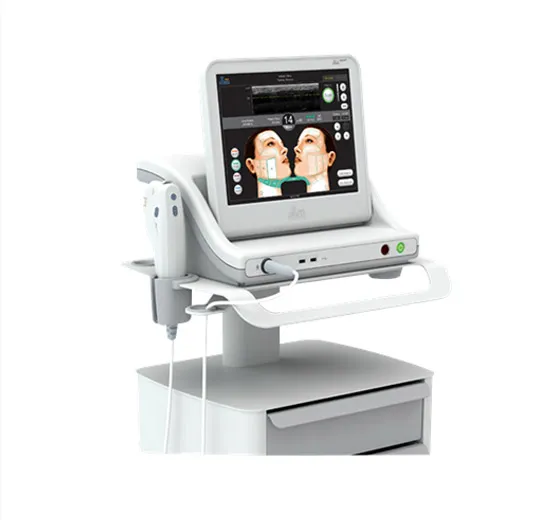 H01
HIFU Machine
High Intensity Focused Ultrasound for SMAS lifting at 1.5mm, 3.0mm and 4.5mm depths - a non-surgical facelift alternative.
View machine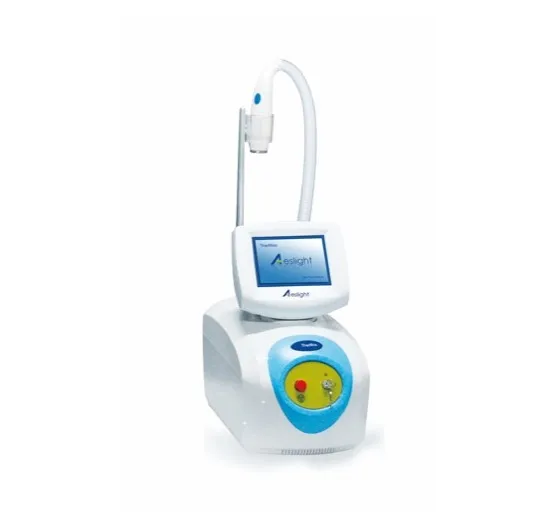 R01
RF Skin Tightening Machine
2.64MHz mono-polar and bi-polar radio frequency for skin firming, wrinkle reduction and body reshaping with contact cooling.
View machineRelated searches
Get a quotation for this solution
Tell us your market and expected volume — factory pricing follows within 12-24 hours.